



By Dan Zarlenga, Missouri Department of Conservation
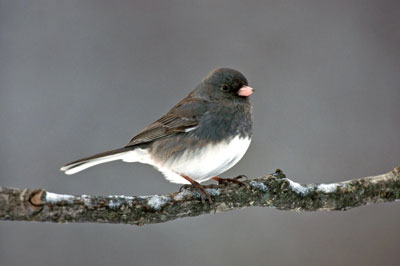
Photo caption: The dark eyed junco. Just an extraordinary, ordinary bird.
Photo by Jim Rathert, Missouri Department of Conservation
It’s just an “ordinary bird”… yet it can carry itself across a continent with little more than the gentlest of scents.
The tiny dark eyed juncos are common winter visitors around backyard bird feeders. You’ll see them everywhere by December in Missouri. They’re often called “snowbirds” because their appearance is as dependable as the first frost. The peppy feeding of these spunky birds brings a delightful energy to the stillness of winter.
The dark-eyed juncos we typically see in this area are of the slate-colored variety. They tend to be light to dark gray all over except for the contrasting white belly and outermost feathers on each side of the tail. This gives them a “half and half” look, as if someone painted the bird dark on top and white on bottom.
Juncos breed in the boreal forests of Canada. Missouri is one of their winter homes, where they spend the coldest months of the year before migrating back north in time for spring.
Many consider juncos just ordinary birds, yet that modest moniker belies the astounding powers possessed by these feathered voyagers. They can “see” magnetic fields and smell their exact position on the continent!
We humans would be challenged to find our way across such immense distances without the help of modern technology, such as compasses and GPS. Yet these “ordinary birds” use their eyes as compasses.
Scientists believe that juncos have cryptochrome molecules present in their tiny retinas. These create light-activated chemical reactions which are sensitive to the orientation of Earth’s magnetic field. This optical magic, which takes place only within blue-green light, enables the junco to accurately determine north and south.
Even more remarkable, dark eyed juncos have olfactory GPS.
Songbirds aren’t usually known for their strong sense of smell, but migratory species like juncos appear to leverage the odor gradients of the land to help them determine their position. Experiments suggest that these birds can literally smell the landscape, homing in on the odors of vegetation, chemicals in the soil, and the smells wafting from lakes, streams, and wetlands. Juncos follow the subtle scents of the land, borne aloft by the winds.
This dual sensory tool kit gives the birds extraordinary powers of navigation. Their ability to read magnetic fields by eye plots the direction of travel. Ascent-powered “GPS” reveals how far they need to fly and when they’ve reached their exact destination.
So, that tiny junco jumping about under your bird feeder has eyed and smelled its way thousands of miles to your yard. And come spring they’ll return to the mountains of Canada that same way, traversing North America by powers that our science has only begun to fathom.
Welcome our junco visitors this winter with a little extra seed in the feeder. Delight in their playful antics. And wonder: what might they be thinking of us Earth-bound humans, blind to magnetic fields and oblivious to the smells of the land?
“They’re so ordinary…”